









Albert Einstein
1879-1955
Major Contribution: His special and general theories of relativity changed the way we view the world and modified many of Newton's proposals.
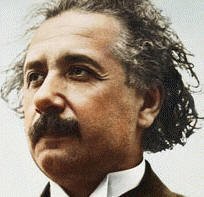 |
Albert Einstein was a German-born theoretical physicist.
He is best known for his theory of relativity and
specifically mass–energy equivalence, expressed by the equation
E = mc2. Einstein received the 1921 Nobel Prize in Physics "for his
services to Theoretical Physics, and especially for his discovery of
the law of the photoelectric effect.” |
||
|
His many contributions to physics include
the special theory of relativity, which reconciled
mechanics with electromagnetism and introduced the concepts of
length contraction and time dilation, and the general theory of relativity. The general theory introduced the concept of space-time Two quotes which give insight into this incredible giant are listed below.
"I have no special talents. I am only passionately curious."
"Imagination is more important than knowledge. Knowledge is
limited. Imagination encircles the world."
|
|||