









James Maxwell
1831-1879
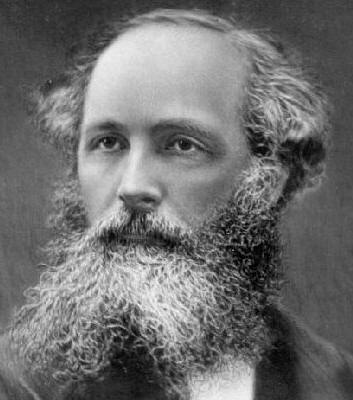 |
James Clerk Maxwell was a Scottish theoretical physicist and mathematician.
His most significant achievement was the development of the classical electromagnetic theory, synthesizing all previous unrelated observations, experiments and equations of electricity, magnetism and even optics into a consistent theory. His set of equations—Maxwell's equations—demonstrated that electricity, magnetism and even light are all manifestations of the same phenomenon: the electromagnetic field.
From that moment on, all other classical laws or equations of these
disciplines became simplified cases of Maxwell's equations.
Maxwell's work in electromagnetism has been called the second great
unification in physics, after the first one carried out by Isaac
Newton.
Maxwell demonstrated that electric and magnetic fields travel through space in the form of waves, and at the constant speed of light. In 1864 Maxwell wrote A Dynamical Theory of the Electromagnetic Field where he first proposed that light was in fact undulations in the same medium that is the cause of electric and magnetic phenomena. |
|
Einstein described Maxwell's work as the "most profound and the most fruitful that physics has experienced since the time of Newton." |
|
His work in producing a unified model of
electromagnetism is considered to be one of the greatest advances in
physics.
Speed of light can be derived from his equations and the speed does not depend on a reference frame