







Niels Bohr
1885-1962
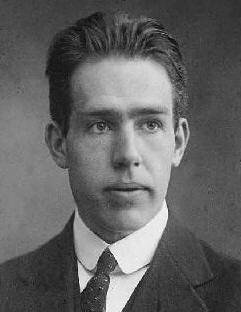 |
Niels Bohr
was born on in Copenhagen,
Denmark. He won the 1922
Nobel Prize for physics, chiefly for his work on atomic
structure.
He suggested that the outer orbits could
hold more electrons than the inner ones, and that these outer orbits
determine the atom's chemical properties.
He became
a Fellow of the
Royal Society of London in 1926, receiving the Royal Society
Copley Medal in 1938. |
|
During World War II, Bohr fled Copenhagen to escape the Nazis. He
traveled to Los
Alamos, New Mexico to advise the scientists developing
the first atomic bomb. He returned to Copenhagen after the war and
later promoted the peaceful use of atomic energy. |
|