Home Robotics C++ Physics II AP Physics B Electronics AP Java Astronomy Independent Study Summer Session Contests  About
                                                       

Aristotle: 384-222 BC


Aristotle argued that the universe is spherical and finite. Spherical, because that is the most perfect shape; finite, because it has a center, viz. the center of the earth, and a body with a center cannot be infinite. He believed that the earth, too, is a sphere. It is relatively small compared to the stars, and in contrast to the celestial bodies, always at rest. For one of his proofs of this latter point, he referred to an empirically testable fact: if the earth were in motion, an observer on it would see the fixed stars as moving, just as he now observes the planets as moving, that is from a stationary earth. However, since this is not the case, the earth must be at rest.


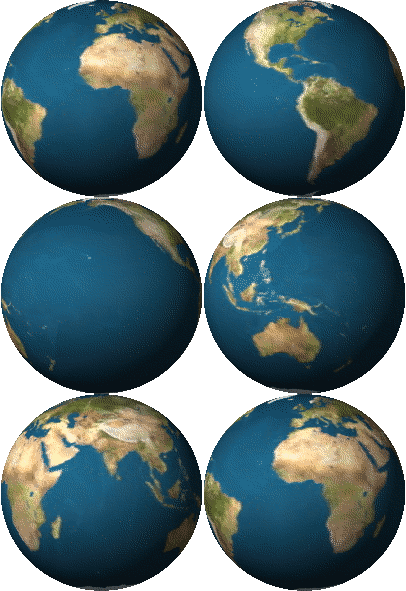
To prove that the earth is a sphere, he produced the argument that all earthly substances move towards the center, and thus would eventually have to form a sphere. He also used evidence based on observation. If the earth were not spherical, lunar eclipses would not show segments with a curved outline.


Furthermore, when one travels northward or southward, one does not see the same stars at night, nor do they occupy the same positions in the sky. That the celestial bodies must also be spherical in shape, can be determined by observation. In the case of the stars, Aristotle argued that they would have to be spherical, as this shape, which is the most perfect, allows them to retain their positions.

By Aristotle's time, the view was that there are four basic elements-earth, fire, and water-had been generally accepted. Aristotle, however, in addition to this, postulateda fifth element called aether, which he believed to be the main constituent of the celestial bodies. This divine element, he believed, is uncompounded, ungenerated, eternal, unalterable, and neither heavy nor light. It can be found in its purest form in the celestial regions, but becomes adulterated in the area below the moon. Aristotle's view of the universe was hierarchical, and he made a sharp distinction between the sub lunar world of change, and the eternal and immutable heavens.


Aristotle, like others before him, believed that each planet followed the path laid out by a certain number of spheres. Aristotle attempted a mechanical explanation, and postulated 22 counteracting spheres, which would set things in balance. It is generally held that Aristotle's addition of these counteracting spheres complicated rather than cleared up the problem of planetary motion.


Aristotle's many-faceted theory of motion was a fundamental part of his world picture. The complexity of this theory is evidenced in the numerous interpretations offered by modern scholars. Here only the bare bones of it will be presented.


According to Aristotle, there were three kinds of motion: rectilinear, circular and mixed. The four elements of the sublunar world tend to move in straight lines: earth downward, fire upward, water and air falling in between. Aether, on the other hand, naturally moves in circles. He further maintained that everything that is moving has to be set in motion by something else, and thus in order to avoid an infinite regress, he posited a first mover. Aristotle's descriptions of such a "prime mover" demonstrate how he mixes physics with metaphysics. In De Caelo, Aristotle equated the prime mover of all things with the sphere of the fixed stars, which was itself moving with unceasing motion.