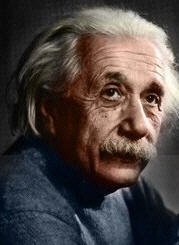
Albert Einstein: 1879-1955
![]() |
Albert Einstein
was a
German-born
theoretical physicist. He is best known for his
theory of relativity and specifically
mass–energy equivalence, expressed by the equation E = mc2.
Einstein received the 1921
Nobel Prize in Physics "for his services to Theoretical
Physics, and especially for his discovery of the law of the
photoelectric effect."
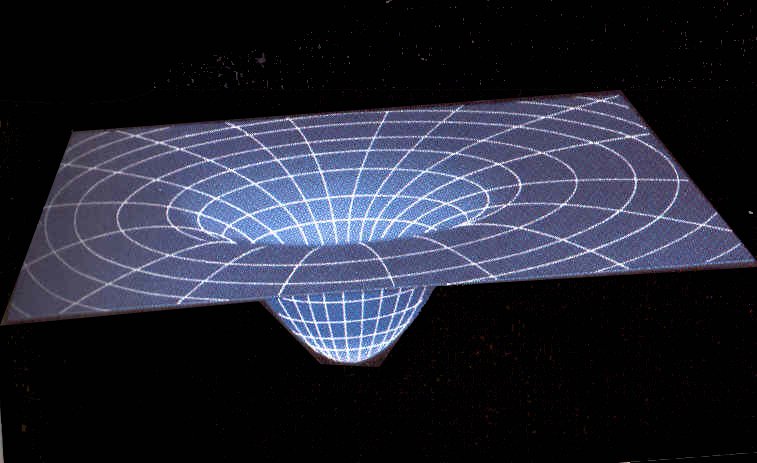
Einstein's many contributions to physics include his special theory of relativity, which reconciled mechanics with electromagnetism, and his general theory of relativity, which was intended to extend the principle of relativity to non-uniform motion and to provide a new theory of gravitation. His other contributions include advances in the fields of relativistic cosmology, capillary action, critical opalescence, classical problems of statistical mechanics and their application to quantum theory, an explanation of the Brownian movement of molecules, atomic transition probabilities, the quantum theory of a monatomic gas, thermal properties of light with low radiation density (which laid the foundation for the photon theory), a theory of radiation including stimulated emission, the conception of a unified field theory, and the geometrization of physics. |
|
"Einstein" has become synonymous with
genius, and he has since been regarded as one of the most
influential people in
human history. |
|