History of Robotics
Origin of the Word Robot
The
first reference to the word robot appeared in a play, Rossum's Universal
Robots (RUR), in London in 1921. The Czech playwright Karel Capek wrote the
play.
Comes from the Czech word for forced labor or serf. RUR's theme was, in part,
the
dehumanization of man in a technological civilization.
Capek was a strong opponent of the Nazis - a quote from him.
"It is with horror, frankly, that he rejects all responsibility for the idea
that metal
contraptions could ever replace human beings..."
A Brief History
A long, long, time ago:
Writings
suggest the notion of robots
1830:
American
Christopher Spencer designs a cam-operated lathe.
1921:
First
reference to word robot appears in a play in London. Czech Karel Capekwrote play.
1938:
American
Willard Pollard designs a programmable paint-spraying mechanism for
the De Vibliss Company.
1946:
George Devol
patents a general-purpose playback device for controlling machines.
1948:
Norbert
Wiener, a professor at MIT, publishes Cybernetics, a book that
describes the concept of communications and
control in
electronic, mechanical, and biological systems.
1951:
Raymond Goertz
for the Atomic Energy Commission designs a teleoperator-
equipped articulated arm.
1954:
George Devol
designs first programmable robot.
1959:
Planet Corporation markets the first commercially available
robot.
1960:
Condec
Corporation purchases Unimation and development of Unimate Robot
Systems begins. AMV Corporation markets a
robot, called the
Versatran.
1962:
General Motors
installs the first industrial robot on a production line.
1964:
AIresearch labs are opened at MIT,
Stanford Research Institute, Stanford University, and the University of Edinburgh.
1968:
SRI builds and
tests a mobile robot with vision
capability, called Shakey.
1970:
At Stanford
University, a robot arm is developed which becomes a standard for
research projects. The arm is
electrically powered
and becomes known as the Stanford Arm.
1973:
Richard Hohn
for Cincinnati Milacron Corporation develops the first
commercially available minicomputer-controlled
industrial
robot. the robot is called T3, the tomorrow tool.
1974:
Professor
Scheinman, the developer of the Stanford Arm, forms Vicarm Inc.
to market a version of the arm for industrial
applications.
The new arm is controlled by a minicomputer.
1976:
Robot arms are
used on Viking 1 and 2 space probes. Vicarm Inc. incorporates
a minicomputer into the Vicarm design.
1977:
ASEA, a
European robot company, offers two sizes of electric powered
industrial robots.
1980:
The robot
industry starts its rapid growth.
The Turing Test
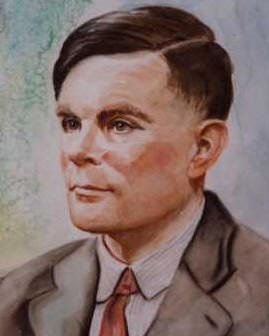
In 1950, Alan
Turingproposed a test to determine machine
intelligence.
The Turing
Test goes like this: a human interrogator is in one room, and a computer
and another human are in another.
Each room has
a terminal in it, through which the interrogator will converse with both
the computer and the other human, one at a time.
If the
interrogator cannot tell which one he is talking to, then the computer is
considered intelligent.
The Loebner Prize

The Loebner
prize is the first formal instantiation of a
TuringTest.
In 1990 Hugh Loebner agreed with the Cambridge Center for Behavioral Studies to
underwrite a contest designed to implement the Turing Test.
Dr. Loebner pledged a grand prize of $100,000 and a gold medal (pictured above)
for the first
computer whose responses were indistinguishable from
a human's.
Each year an annual prize of $2,000 and a bronze medal is awarded to the most
human computer.
Asimov's Original 3 Laws
A robot may not injure a human being, or, through inaction, allow a human to
come
to harm.
A robot must obey orders given to him by human beings except where such orders
would conflict with the First Law.
A robot must protect its own existence as long as such protection does not
conflict
with the First or Second Law.